
Nutritional Yeast
Notes from the Kitchen


Nutritional yeast does not enter the kitchen as an obvious ingredient. It does not arrive wrapped in tradition or nostalgia, nor is it tied to a gesture learned in childhood. It appears instead as an anomaly, a golden powder with no clear past, recommended by someone who cannot always explain exactly what it is, but insists that it works. The confusion is almost inevitable. The word yeast carries with it the idea of fermentation, of doughs that rise, of beer, of microscopic life in motion. Nutritional yeast does none of that. And it is precisely there that its interest begins.
Those who try it for the first time usually do so with a certain skepticism, using it sparingly over pasta, a soup, or roasted vegetables, and discovering that it does not taste like cheese, yet behaves like it, occupying the same structural place on the plate. It does not imitate or replace, nor does it attempt to deceive the palate, but rather adds depth and continuity, leaving a lingering impression that is difficult to pinpoint with precision. This is why the recurring comparison to parmesan, though imprecise, works as an effective intuition, because it points to a culinary function rather than a recognizable flavor.
From a technical standpoint, nutritional yeast is easy to define. It is a deactivated yeast, most often Saccharomyces cerevisiae, grown on a sugar rich medium, harvested, heated, and then dried into flakes or powder. The process stops biological activity, so the cells are no longer alive and no longer ferment, produce gas, or transform the food they are added to. Their role is not to act, but to be present. Paradoxically, that passivity is what makes nutritional yeast such an active ingredient in the kitchen.
Its origin is not gastronomic, but nutritional. In the early twentieth century, in a context shaped by scarcity and concerns about malnutrition, European researchers began exploring yeast as a concentrated source of protein and B vitamins, conceived more as a functional solution than as a culinary ingredient. For decades, its use remained tied to supplementation and to a near clinical view of food, closer to the laboratory than to the table, a narrative in which there was no room for pleasure, only for efficiency.
The shift came much later, when nutritional yeast was embraced by the natural foods movement and later by vegetarian and vegan kitchens that were looking for more than substitutes. In that context, it ceased to be a supplement and became an ingredient, not because it literally replaced anything, but because it offered an elegant answer to a persistent and complex question, how to build deep flavor without relying on animal products. It was also then that it began to be called nooch, an informal abbreviation born in English speaking vegetarian and vegan communities, particularly in the United States, a name that does not describe the ingredient in technical terms, but through everyday use, stripping away its clinical tone and bringing it closer to the domestic language of the kitchen.
What is it made of
Nutritional yeast is naturally rich in glutamic acid, the same amino acid responsible for the sensation of umami found in foods such as aged parmesan, ripe tomatoes, or mushrooms, and it is complemented by nucleotides such as inosinate and guanylate, compounds that do not contribute flavor on their own, but amplify and prolong taste perception when they act together with glutamate. The result is not an immediate impact, but a sustained resonance, a flavor that does not burst onto the palate, but lingers, interacts with other tastes, and finds its meaning within the dish.
In pasta it does not substitute cheese, but works as an invisible structure that supports the whole and brings depth and umami. In a soup it does not appear as an obvious seasoning, but as a quiet base that organizes flavor. In simple preparations, without unnecessary layers, it works best when balance is already well resolved. Nutritional yeast does not mask weak dishes, it rewards well constructed ones.
Production and varieties
The production process, far from being uniform, introduces nuances that explain much of its sensory diversity. The growth medium influences the aromatic compounds that develop, the type of heat and the duration of inactivation can create more toasted or softer profiles, the drying method affects both texture and how the product integrates into a dish, and even fortification, especially with vitamin B12, can slightly alter the final character. Not all nutritional yeasts taste the same, and that variability is an essential part of their culinary interest.
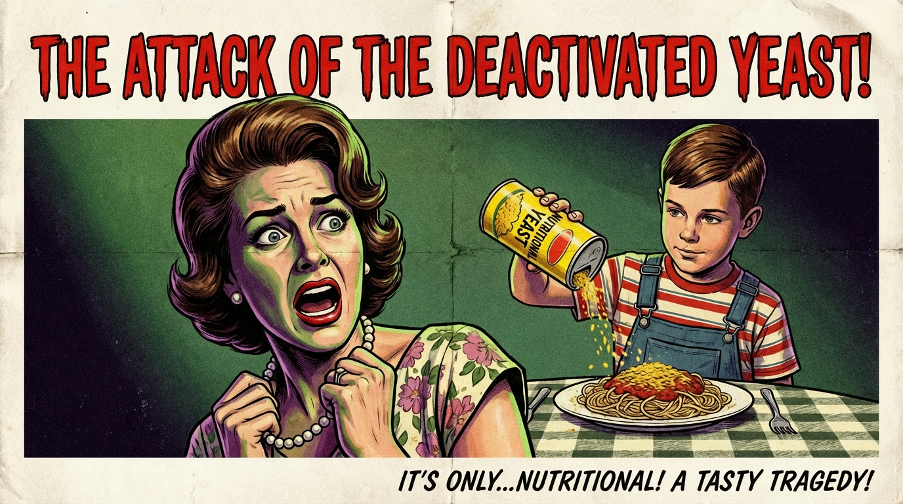
Careful with overuse, it can cause candida
Alongside its growing popularity, a persistent misunderstanding has also taken hold, the idea that because it is a yeast, nutritional yeast promotes or causes candida. The confusion is understandable from a linguistic point of view, but it does not hold up biologically.
It is worth clarifying a common misconception. It is not yeast itself that causes candida overgrowth, but the biological context in which it is introduced. Candida proliferates when the ecosystem is imbalanced, most often due to an excess of available sugars, disruptions in the microbiota, or a compromised immune system, not because of the mere presence of a yeast. Moreover, not all yeasts behave in the same way. Some are alive and fermentative, others are inactivated and lack biological activity altogether. Nutritional yeast belongs to the latter category. It does not colonize, reproduce, or ferment in the body, and consuming it does not mean introducing an active microorganism, but rather ingesting a food composed of inactivated cells and their components.
This type of confusion reveals something interesting about our relationship with contemporary ingredients, many of which arrive in the kitchen without a clear narrative and burdened with inherited terms that no longer accurately describe what is happening. Nutritional yeast does not fit neatly into traditional categories, and perhaps that is why it is such a representative ingredient of modern cooking.
It does not transform matter through direct action, but through the way it reorganizes the whole. It does not impose flavor, it reshapes balance. It is a quiet but structural ingredient, capable of connecting nutrition, technique, and pleasure without demanding the spotlight, at a time obsessed with visible processes, long fermentations, and spectacular gestures.
Against all of that, nutritional yeast proposes something else, knowing when to stop a process and understanding what remains when activity ceases.
From a microscopic organism to a golden powder capable of redefining an entire dish, nutritional yeast shows that flavor does not always arise from fire, from time, or from constant transformation, and that sometimes it emerges precisely from stillness, from what no longer acts, yet continues to say a great deal.