
Tapioca Pearls
Notes from the Kitchen


At first glance, tapioca pearls may seem like a minor ingredient: small, glossy spheres associated with sweetness, playfulness, and the unmistakable chew of bubble tea. For many cooking enthusiasts, they are also perceived as something exotic, often linked almost exclusively to Asia as their place of origin. Yet, as with many foods that have crossed different geographies and historical periods, this apparent simplicity conceals a far more complex story. Behind their elastic texture lie centuries of cultivation, forced migrations, cultural adaptation, and an intuitive understanding of matter that long predates modern food science.
Tapioca comes from cassava, also known as yuca, a root native to South America that was cultivated for thousands of years by Indigenous peoples long before the arrival of Europeans. In that context, cassava was not merely a source of energy, but a body of knowledge passed down through generations: how to process it, how to neutralize its natural toxins, how to turn it into flour, bread, or starch. From this root comes a starch that is almost neutral in flavor, gluten free, and structurally open, a material defined less by what it is than by everything it has the potential to become. This material is tapioca. In the kitchen, tapioca functions as a blank canvas, capable of absorbing technique, context, and intention without imposing a character of its own.
That neutrality, far from being a limitation, is a form of potential. When cassava began to travel beyond South America, it did so along Portuguese and Spanish colonial routes during the sixteenth and seventeenth centuries. The root was introduced first to Europe and, above all, to Africa and Asia, where it adapted easily to tropical climates and diverse soils. In many of these regions, cassava became a strategic crop due to its resilience, high yield, and ability to sustain entire populations. Along with it traveled tapioca, not as a finished product, but as a raw material ready to be reinterpreted.
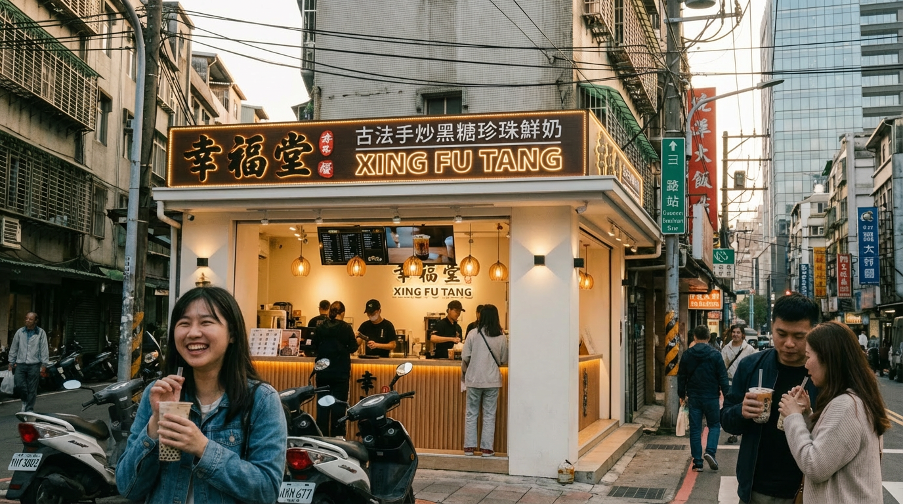
In Asia, that reinterpretation took on a distinctive form. From the nineteenth century onward, cooks began working tapioca starch as a malleable mass, shaping it into small pearls that were cooked in sweet soups, desserts, and warm preparations. At the same time, in Europe and the United States, tapioca established itself as a domestic ingredient through puddings and creams that emphasized softness and comfort. Much later, in 1980s Taiwan, the emergence of bubble tea completely transformed the perception of tapioca pearls, elevating them to a global icon and placing texture, rather than flavor alone, at the center of the sensory experience.
The tapioca is particularly rich in amylopectin, a polysaccharide that, when heated in water, forms an elastic, sticky gel capable of retaining moisture without losing cohesion. This property is what gives tapioca pearls their characteristic chew, a texture that Taiwanese cuisine describes as QQ, flexible, elastic, and alive under the bite.
It is neither soft nor hard, but reactive, a texture that responds and leaves a memory. It is perhaps comparable, in gastronomic terms, to what in Italy we refer to as al dente, a way of cooking pasta that respects certain parameters and limits in pursuit of a very specific sensory experience.
The production of tapioca pearls reflects this direct relationship between simplicity and transformation. Cassava starch is mixed with hot water until the granules gelatinize and form a flexible dough. That dough is rolled or sifted into countless tiny spheres, which are then dried for preservation or cooked directly. During cooking, the pearls undergo a visible and significant transformation, shifting from opaque white pellets into translucent, glossy, elastic gems with their characteristic bounce. Powder becomes pearl, and structure becomes sensation.
Although today this process is replicated on a large scale through industrial machinery, the principle remains the same as it was centuries ago. Heat, water, and time reorganize matter. What changes is not the logic, but the rhythm and the scale.
Because of their structural density, tapioca pearls demand precision in cooking. Undercooked, they remain hard and opaque. Overcooked, they lose definition and integrity. Their ideal texture exists within a narrow window that rewards attention and patience more than speed. In this sense, tapioca pearls do not tolerate neglect and require cooking with intention.
Seen from this perspective, tapioca pearls have less to do with contemporary trends and more to do with the continuity of material knowledge. From the Indigenous cultivation of cassava to their presence in street drinks and fine dining dishes, they demonstrate how an ingredient can travel through space and time without losing its essential identity. They may appear light or even playful, but they carry with them a history of adaptation, cultural exchange, and a deep understanding of texture as a culinary language.
In the end, tapioca pearls remind us that gastronomy does not advance solely through technical complexity or constant innovation. Sometimes it moves forward through repetition, displacement, and the ability to listen to matter itself. What begins as a root becomes a pearl, and what seems like a simple addition reveals itself as a long story of transformation, patience, and edible memory.